When Your Customer Isn't the Point
There is a version of this collaboration that everyone expected, and it never existed.
When Swatch and Audemars Piguet confirmed their partnership earlier this month, the internet immediately started rendering it. AI-generated images flooded social media: brightly coloured bioceramic Royal Oaks, plastic octagonal bezels, eight hexagonal screws in candy colours. The assumption was almost universal...this would be a MoonSwatch moment. A $400 version of the world's most coveted luxury sports watch, worn on a wrist, queued for outside Swatch boutiques, flipped on StockX before noon.
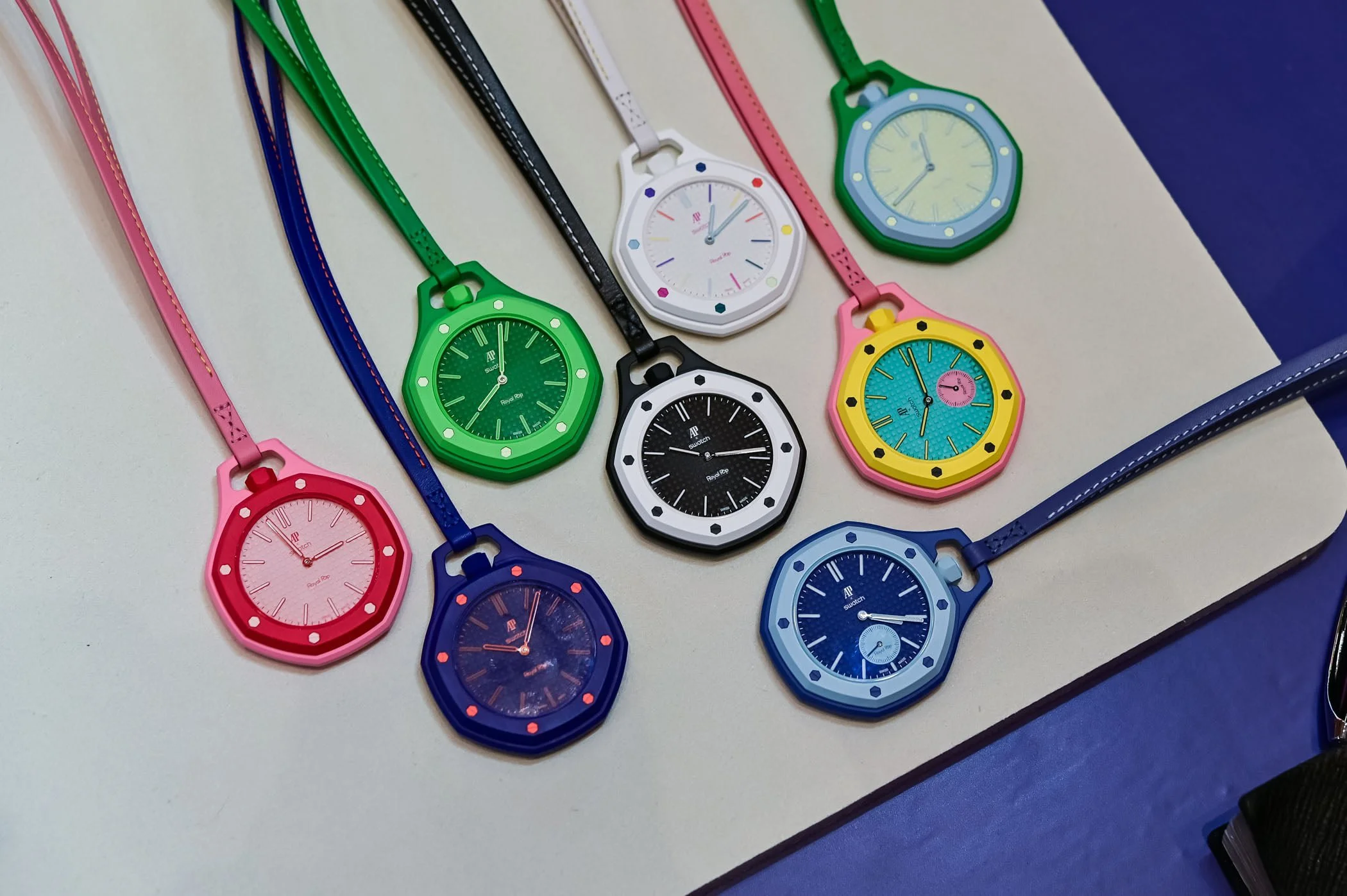
Instead, AP and Swatch sidestepped the obvious move entirely. The Royal Pop is not a plastic Royal Oak wristwatch in the way the MoonSwatch reimagined the Omega Speedmaster. In fact, it has been specifically designed not to be worn on the wrist at all. It is a pocket watch...Pop Art in spirit, modular in construction, worn on a calfskin lanyard or clipped to a bag. The reveal disappointed many people. It also, almost immediately, sold out.
That gap...between what people wanted and what they lined up to own anyway...is worth sitting with. Because the Royal Pop isn't a story about a product. It's a story about what brands are actually for.
The clientele question
The most common critique of this collaboration, from both ends of the market, runs something like: these two brands have nothing to do with each other. Swatch buyers will never own a Royal Oak. AP collectors would never be caught dead with a Swatch. So what exactly is the point of the exercise?
“The Royal Pop isn’t a story about a product. It’s a story about what brands are actually for.”
This question assumes that a successful brand collaboration requires an overlapping customer base. That the deal only makes sense if Swatch's audience graduates upward, or if AP's collectors condescend to play along. Neither thing is likely to happen at meaningful scale, and neither brand is pretending otherwise.
The more honest framing is aspirational. A former AP CEO noted the analogy directly: Porsche advertised in magazines that were never aimed at people who could afford a 911. They wanted to be seen by a larger audience, to plant a seed...to exist in the imagination of people who might one day be in the market, or who might simply carry the brand's meaning forward into the culture. The Royal Pop operates on a similar logic. AP is positioned firmly in the high-net-worth segment, a demographic that skews older. The collaboration addresses a long-term brand perception risk that expensive heritage brands consistently face with younger consumers.
This is a category of brand work that rarely gets named cleanly. It isn't advertising. It isn't product extension. It is cultural presence...the deliberate act of making your brand legible and desirable to people who are not, and may never be, your customer.
The pocket watch was the brave call
The genius of the Royal Oak lies in its immaculate finishing and untouchable prestige. Translating that exact silhouette into a plastic, sub-$1,000 watch meant for hypebeasts invites direct comparison to the real thing and risks trivialising the icon in the eyes of elite collectors. AP understands this. So instead of building a wristwatch that would sit alongside the Royal Oak and invite unflattering comparisons, they built something that lives in an entirely different register. Man of Many
“The fear is usually framed as a binary: either you protect the brand by keeping it narrow, or you grow the audience by opening it up. The Royal Pop suggests a third option.”
If it's a playful accessory that isn't trying to replace or imitate a $60,000 luxury timepiece, it exists in a totally different category...and allows AP to democratise the brand and educate a younger generation without cheapening the actual wristwatch experience. The pocket watch format is not a consolation prize. It is the protection mechanism. It is what makes the whole strategy coherent.
The people who are annoyed, (and there are many) reacting to what they didn't get, not to what was made. One critic was blunt: "Swatch and Audemars Piguet had an incredible opportunity to create the item of the summer if the piece was a wristwatch... A pocket watch that is only going to be seen outside on the streets of SoHo is an absolute L." That criticism is coherent on its own terms. But it misreads the brief entirely. AP was never going to put its most iconic design onto someone's wrist for $630. That was never available. The disappointment is real, but it is the disappointment of an expectation that was never realistic.
What Labubu has to do with it
The comparison being made most frequently in the trade press right now is to Labubu...Pop Mart's vinyl collectibles that, for a period last year, were dangling from luxury handbags in every city on earth. The analogy is more revealing than it might first appear.
Marketers have noted that the Royal Pop reflects luxury's shift towards collectibles with attachable identities. In this case, it's a pocket watch designed to clip onto bags, much like Labubu, and priced accessibly enough to manufacture the same kind of drop-culture hype. Research by Kantar describes a generational shift in how luxury is consumed: where millennials purchased as a status marker, Gen Z treats luxury as a tool for self-expression and identity curation.
The Royal Pop understands this. It is not asking to be worn as a timepiece. It is asking to be carried as a signal...a statement of taste, of cultural fluency, of knowing what a Royal Oak is even if you've never held one. Lanyards, pendants, and chain-worn accessories are not alien to a generation raised on streetwear and festival culture. Wearing a timepiece around your neck rather than your wrist is, in that context, a statement of style fluency rather than an oddity.
The brand strategy lesson
What Audemars Piguet has done here is something that most heritage brands find almost impossible: it has allowed its most protected asset...the Royal Oak's design language...to exist in a form that will never threaten the original. The octagonal bezel, the tapisserie dial, the eight visible screws: all of it is present and legible. The icon travels. But it travels in a format that is categorically different from the thing it references, which means the original loses none of its rarity or prestige in the process.
AP CEO Ilaria Resta put it simply: "The only way to play safe is to not do anything. And that's not in AP's DNA."
For brands navigating questions of reach versus exclusivity, this is instructive. The fear is usually framed as a binary: either you protect the brand by keeping it narrow, or you grow the audience by opening it up and accepting the dilution that follows. The Royal Pop suggests a third option...that the right collaboration, with the right format and the right constraints, can expand cultural presence without touching brand integrity at all.
The MoonSwatch sold around two million pieces across 36 variations and introduced an entirely new audience to Swiss watches. Whether the Royal Pop matches that scale is secondary. What matters is that AP's name is now in conversations it was never in before...on TikTok feeds, on the bags of people who would never step inside a boutique, in the minds of a generation that will grow into the market over the next decade.
That is not a side effect of the collaboration. It is the entire point of it.
And the fact that most of those people will never own a Royal Oak? That, too, is the point and I love it.