
Canva spent a decade convincing the world it didn't need a designer. Now the world has found something that doesn't need Canva either.
The pitch was never really about design. It was about not needing someone.
That was the quiet genius of Canva. It didn't sell better design... it sold the removal of a step. No brief, no back and forth, no invoice from a studio. Pick a template, swap the logo, change the headline, export. The thing that used to take a week and a person now took ten minutes and a login. Millions of people discovered they could make the poster for the school fete, the menu for the café, the deck for the board meeting, and that it would be fine. Not brilliant. Fine.
Fine turned out to be enormous. Fine was a market of hundreds of millions.
Somewhere along the way the briefs changed shape. Less here's the problem, more here's what we've done. I remember the first time a client sent through something they'd built themselves and asked if we could just tidy it up. They weren't being dismissive. They hadn't decided design didn't matter. They'd decided that a version of it was now free, and they only needed us for the last ten per cent.
That was the moment the value moved, and Canva was the one moving it. It taught a generation that the result matters more than the process, that speed is a form of quality, that a template can stand in for a decision. It taught that lesson better than any design school ever taught the opposite.
“It is racing to perfect the thing that makes it unnecessary.”
Which is why this week reads less like a company ambushed by a competitor and more like a company caught by its own argument.
“Canva, one of Australia's best known start-ups, has announced a shake up of the business that will affect 22% of its workers, including job cuts.”
If the value of design is that anyone can make it, instantly, without expertise, the obvious next question is why it needs to be made in Canva at all. Type a sentence into a chat window and something appears. Layered, editable, on brand enough. The template has been replaced by the prompt, and the prompt doesn't need an app.
Canva has seen this coming. Its answer has been to become the machine itself... conversational design, agents that build the thing for you, a platform rebuilt around asking rather than making. It's the sensible move. It's also a trap. Every step towards just ask and it appears is a step further down the road that leads away from needing Canva. It is racing to perfect the thing that makes it unnecessary.
That's what being your own worst enemy actually looks like. Not a mistake. A success with a long tail.
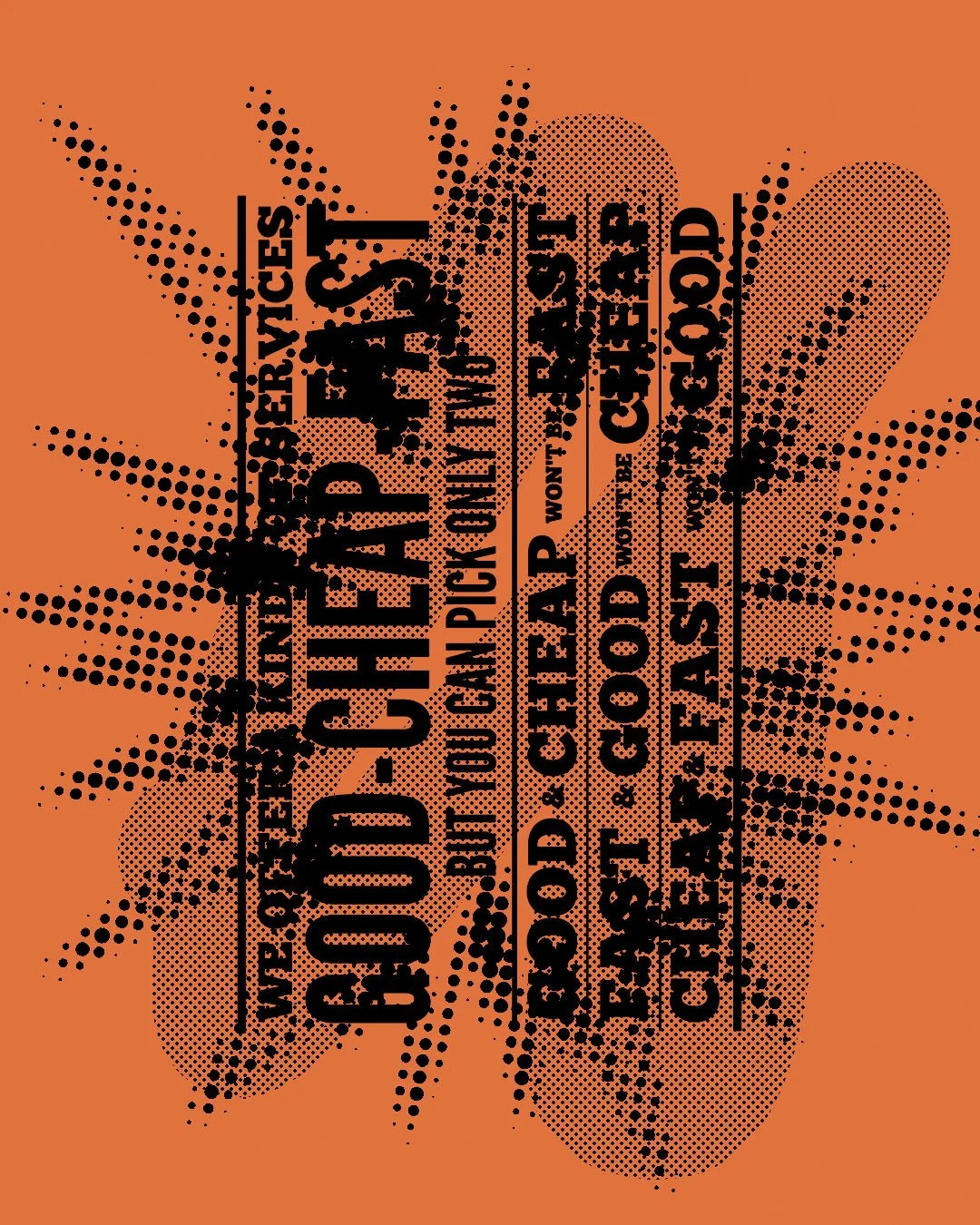
There's an old line in this industry: fast, cheap or good, pick two. Canva's insight was that most people would happily pick fast and cheap, and that good could be quietly redefined as whatever fast and cheap produced. A decade of growth was built on that redefinition. The trouble with redefining good downward is that you don't get to choose where it stops. Someone always arrives faster and cheaper. This time it isn't a someone.
“Canva made design accessible by making it interchangeable. Interchangeable things get interchanged.”
None of this is said with any pleasure. Canva began as a Perth idea... a student teaching classmates clunky design software and thinking there had to be an easier way. That impulse was generous. Design had been gatekept by expensive tools and expensive people, and prising it open was a real thing to do. The fete posters got better. Small businesses who would never have walked into a studio got something with a hierarchy and a typeface that wasn't Comic Sans. That counts for something.
But generosity and commodification look identical from the outside, and the market only pays for one of them. Canva made design accessible by making it interchangeable. Interchangeable things get interchanged.
The harder question is for the rest of us, and whether we were part of the lesson. Studios that competed on turnaround. Agencies that sold the deliverable instead of the thinking behind it. Every time the industry priced itself by the asset, it quietly agreed with Canva's premise... that the output was the value. The output was always the cheapest part. The judgement about what to make, and why, and for whom, was the bit nobody could template. It's also the bit nobody can prompt, though plenty are trying.
Maybe the restructure works. Smaller teams, sharper focus, a company that remembers what it was for. But what it was for is exactly the problem. Anyone can design was a promise and a price cut delivered in the same breath, and it's never been clear which one the world actually bought.
